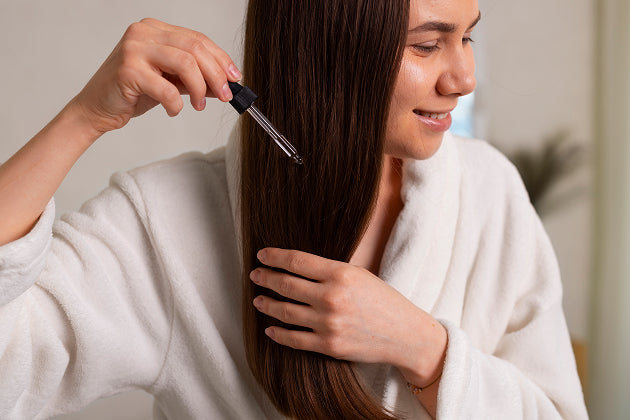
If you've been staring at your hairline, wondering when that bottle of hair growth oil will finally kick in, you're not alone. The honest answer? Most people start seeing noticeable results from hair growth oils between 8 and 16 weeks of consistent use.
Here's the reality check: hair doesn't grow overnight, no matter what those before-and-after photos on social media might suggest. Your hair follicles are working on their own biological timeline, and while growth oils can absolutely help speed things up and improve hair quality, they're not magic potions.
The key is setting realistic expectations and understanding what's actually happening beneath your scalp during this waiting period.
The Hair Growth Cycle: Why Results Take Time
Before diving into timelines, let's talk about why hair growth can't be rushed. Your hair follows a natural four-phase cycle that determines when and how fast it grows:

- Anagen Phase (Growing Phase): This is when your hair actively grows, lasting 2-7 years. About 85-90% of your hair is in this phase at any given time.
- Catagen Phase (Transition Phase): A brief 2-3 week period where hair stops growing and the follicle shrinks.
- Telogen Phase (Resting Phase): Hair rests for about 2-3 months before eventually falling out.
- Exogen Phase (Shedding Phase): Old hairs shed to make room for new growth.
Hair growth oils work by nourishing the scalp, improving blood circulation, and supporting follicles during the anagen phase. But here's the thing, if your hair is currently in the telogen or exogen phase, you won't see new growth until it cycles back to anagen. This is why patience is crucial.
On average, hair grows about 0.5 to 1.7 centimeters per month, or roughly 6 inches per year. Even the most effective hair growth oils can't dramatically speed up this biological process – they can only optimize the conditions for healthy growth.
What to Expect Week by Week: A Realistic Hair Growth Oil Timeline
Here's what you can realistically expect when using a quality hair growth oil consistently:
|
Timeline |
What's Happening |
What You'll Notice |
|
Weeks 1-2 |
Scalp conditioning begins, and blood circulation improves |
Scalp feels healthier, less itchy or flaky |
|
Weeks 3-4 |
Follicles receive better nourishment, and shedding may reduce |
Less hair in your brush, scalp feels more supple |
|
Weeks 5-8 |
New hair enters the growth phase, existing hair strengthens |
Baby hairs along the hairline, reduced breakage |
|
Weeks 9-12 |
Visible new growth, improved hair quality |
Noticeable thickness, length, and overall health |
|
Week 12+ |
Continued improvement with consistent use |
Significant transformation in hair density and quality |
Factors That Affect Your Hair Growth Oil Results Timeline
Not everyone's hair growth journey looks the same. Several factors can speed up or slow down your results:
Hair Type and Texture
-
Fine hair: Often shows results faster because changes are more noticeable
-
Thick, coarse hair: May take longer to see visible changes but often experiences more dramatic results
-
Curly or textured hair: May need longer to show length but often sees improved thickness sooner
As one Reddit user, put it:
“Patience. Curly hair takes much longer to gain visual length because it is growing around in circles not just a straight line up to down. Basic physics.”

Underlying Causes of Hair Loss
-
Genetic factors (androgenetic alopecia): May require longer timelines and realistic expectations
-
Stress-related hair loss: Often responds well and relatively quickly to nourishing oils
-
Nutritional deficiencies: Results improve dramatically when combined with proper nutrition
-
Hormonal changes: May need medical intervention alongside topical treatments
Consistency of Application
This cannot be overstated, sporadic use leads to sporadic results. Daily application typically shows results 2-3x faster than occasional use.
Diet and Overall Health
Your hair growth is directly linked to your nutrition. Adequate protein, iron, and vitamins significantly impact your timeline.
Age Factors
Younger individuals typically see faster results due to more active follicles and better circulation.
As one Reddit user, shared:
“Wow, this just made me realize why my hair seems to not even grow anymore. It used to grow pretty fast. I assumed getting older made it slow down but duh! It was just that it’s curlier. So frustrating!”

Scalp Health
A healthy, well-circulated scalp responds much faster to growth oils than one dealing with buildup, inflammation, or poor circulation.
Ingredients in Hair Growth Oils and Serums
Understanding what's in your hair growth oil can help set realistic timeline expectations. Here are the key players and what they do:
Scientifically-Backed Ingredients
Rosemary Oil: Studies show it's as effective as 2% minoxidil for androgenetic alopecia. Results typically visible after 6 months of use.
Castor Oil: Rich in ricinoleic acid, which improves circulation and has anti-inflammatory properties. Known for strengthening hair and reducing breakage.
As one user, shared:
“A mix of castor oil, rosemary oil and moringa oil literally regrew my hair. I thought I was starting to get female pattern baldness and I freaked. The stuff is awesome…”

Biotin: While topical biotin's effectiveness is debated, it's crucial for keratin production. Deficiency can cause hair thinning.
Camellia Oil: Cold-pressed from Camellia oleifera seeds, this oil has a remarkably similar molecular structure to human sebum, making it incredibly compatible with both scalp and hair.
If you’re looking to incorporate this nourishing ingredient into your routine, check out our Hair Growth Oil Spray. It features Camellia Oil alongside other beneficial ingredients, designed to support a healthier scalp and encourage hair growth.
Peppermint Oil: Increases blood circulation to follicles. Studies show significant hair growth improvement in 4 weeks.
Argan Oil: Packed with vitamin E and fatty acids, it prevents breakage and adds shine. Results in hair quality are visible within 2-4 weeks.
Caffeine: Counteracts DHT (the hormone responsible for male pattern baldness) and stimulates follicles. Studies show effects within 2 months.
What to Avoid
-
Sulfates: Strip natural oils and can cause scalp irritation
-
Parabens: May disrupt hormone balance
-
Mineral oils: Can clog pores and prevent other beneficial ingredients from penetrating
-
Synthetic fragrances: Often cause scalp sensitivity
Look for oils with a short, clean ingredient list focusing on proven botanical extracts and essential oils.
Signs Your Hair Growth Oil Is Actually Working
Sometimes results happen before you can see them. Here are the early signs your hair growth oil is working:
Reduced Hair Shedding (Usually first sign, weeks 2-4)
Less hair in your brush, on your pillow, or going down the drain during washing. This indicates your hair is getting stronger and your follicles are healthier.
Improved Scalp Health (Weeks 1-3)
Your scalp feels less itchy, tight, or flaky. You might notice reduced dandruff or scalp irritation.
Baby Hairs Appearing (Weeks 4-8)
Look closely at your hairline and part. Fine, short hairs that weren't there before are new growth.
Hair Feels Thicker (Weeks 6-10)
Even before visible length changes, your hair may feel fuller when you run your hands through it.
Reduced Breakage (Weeks 3-6)
Your hair snaps less when styling or brushing, indicating improved strength and moisture.
Common Mistakes That Slow Down Hair Growth Oil Results
Avoid these pitfalls that can significantly delay your results:
Not Massaging Into the Scalp Properly
You need to massage it into your scalp for 3-5 minutes to stimulate circulation and ensure the active ingredients reach your follicles.

Using Too Much Product
A few drops massaged thoroughly is more effective than drowning your scalp.
Inconsistent Application
Skipping days or weeks disrupts the process. Hair follicles need consistent nourishment to maintain improved growth patterns.
Using Low-Quality Oils
Products with fillers, synthetic ingredients, or low concentrations of active ingredients simply won't deliver results regardless of how long you use them.
Ignoring Underlying Issues
If you have hormonal imbalances, nutritional deficiencies, or medical conditions affecting your hair, topical treatments alone may not be sufficient.
How to Maximize Your Hair Growth Oil Results
Want to see results on the faster end of the timeline? Here's how to optimize your routine:
Perfect Your Application Technique
-
Apply to a slightly damp scalp for better absorption.
-
Use fingertips to massage in circular motions for 3-5 minutes.
-
Focus on problem areas but don't neglect the entire scalp.
-
Apply consistently at the same time daily to build a habit.

Support Growth from Within
Include these hair-healthy nutrients in your diet:
-
Protein: Hair is made of keratin, a protein.
-
Iron: Deficiency is linked to hair loss.
-
Biotin and B-vitamins: Essential for hair cell production.
-
Omega-3 fatty acids: Keep hair shiny and strong.
-
Zinc: Supports hair tissue growth and repair.
Minimize Damage
-
Reduce heat styling or use heat protectants.
-
Sleep on silk or satin pillowcases to prevent friction.
-
Avoid tight hairstyles that stress the hairline.
-
Be gentle when brushing, especially when wet.
Track Your Progress
Take photos from the same angles in the same lighting monthly. Progress photos often reveal changes you might miss in daily mirror checks.
Frequently Asked Questions
How long does it take to see growth from hair oil?
Most people see initial signs of new growth between 6-8 weeks of consistent daily use, with significant results visible by 12-16 weeks. The exact timeline depends on your hair type, the cause of your hair concerns, and how consistently you apply the product.
Can hair grow 2 inches in 2 weeks?
No, this is biologically impossible. Hair grows approximately 0.5 inches per month on average.
Do hair growth oils actually work?
Yes, when they contain clinically proven ingredients like rosemary oil, Camellia Oil, peppermint oil, and caffeine. Studies show these ingredients can improve circulation, reduce inflammation, and even match the effectiveness of conventional treatments like minoxidil. However, results take time and consistency.
Is 30 minutes enough for oiling hair?
For hair growth purposes, you don't need to leave oil on for hours. The active ingredients in quality hair growth oils absorb within 15-30 minutes. What matters more is consistent daily application and proper scalp massage during application. Some people prefer to leave oil on overnight, but it's not necessary for effectiveness.
What if I don't see results after 16 weeks?
If you haven't seen any improvement after 4 months of consistent use, consider consulting a dermatologist or trichologist. You may have underlying medical conditions like thyroid issues, hormonal imbalances, or autoimmune conditions that require medical intervention alongside topical treatments.